
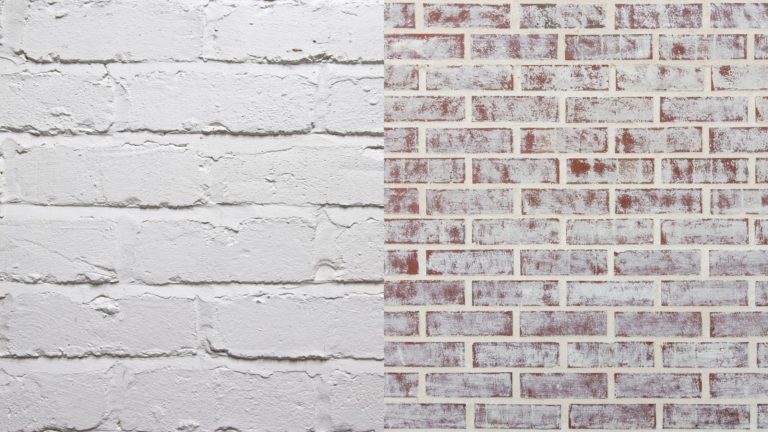
If you want to update brick without covering all of its natural texture, you may be considering limewash or whitewash.
Both finishes can soften the color of brick and create a lighter, more updated appearance. However, they work differently and can produce very different results.
Limewash is a mineral-based finish that works best with porous masonry, while modern whitewashing usually involves diluted paint applied in a thin, semi-transparent layer.
The right choice depends on the surface you are working with, the look you want, and whether the brick has already been painted or sealed.
What Is Limewash?
Limewash is traditionally made from lime, water, and mineral pigments.
It is commonly used on porous surfaces such as brick, stone, and other masonry. Rather than creating a heavy painted layer, limewash works closely with the surface and allows much of the original masonry texture to remain visible.
The finished look is usually soft, matte, and slightly uneven. That natural variation is one of the reasons homeowners choose limewash.
It works especially well when the goal is to create an aged, European, or historic appearance without completely hiding the brick underneath.
For owners of older homes, the existing surface should always be considered before choosing a coating. Our guide to historic home painting in Rhode Island explains why older materials can require a more careful approach.
What Is Whitewash?
Whitewash can mean different things depending on the product and application method.
Traditional whitewash was also lime-based. Today, however, many homeowners use the term to describe diluted latex or acrylic paint that is applied lightly over brick.
The goal is usually to brighten the masonry without giving it the solid appearance of fully painted brick.
Because paint-based whitewash can be adjusted through color and dilution, homeowners often have more control over the final look. The brick can remain fairly visible, or the finish can be made much brighter and more uniform.
Limewash vs. Whitewash: The Main Difference
The biggest difference between limewash and whitewash is how the coating behaves on the surface.
Limewash is a mineral finish that works especially well with bare, porous masonry. Modern paint-based whitewash behaves more like a thin layer of paint.
That difference affects everything from appearance and color selection to breathability and maintenance.
Limewash generally has a softer, more naturally weathered finish. Whitewash tends to look cleaner and gives homeowners more control over how much of the original brick shows through.
How Do They Look Different?
Limewash is usually chosen for its variation.
Some areas of the brick may appear lighter than others, which creates a more natural and aged finish. It is not meant to look perfectly uniform.
Whitewash can still look soft and textured, but it is usually easier to control. A light application can allow plenty of the original brick color to show, while a heavier application can create a much brighter appearance.
If your priority is an organic, weathered look, limewash may be the stronger choice.
If you want more control over color and coverage, whitewash may be easier to customize.
Which Finish Offers More Color Options?
Whitewash usually gives you more flexibility.
Because modern whitewashing often uses diluted paint, the finish can be created using a much wider range of colors.
Limewash colors are typically more muted and mineral-inspired. Whites, creams, warm neutrals, and earthy tones are common.
For indoor brick, color should also work with the surrounding walls, trim, flooring, and furniture. If the brick is part of a larger room update, our interior house painting services can help create a more coordinated finished look.
What About Breathability?
Breathability is an important consideration with masonry.
Limewash is naturally breathable when it is used on a compatible surface. This allows moisture vapor to move through the masonry rather than becoming trapped behind a dense coating.
Paint-based whitewash can behave differently depending on the product used.
This becomes especially important with exterior brick and older masonry, where moisture movement can affect long-term performance.
It is also why the existing condition of the brick matters. Bare brick, sealed brick, and previously painted brick may all require different approaches.
Limewash vs. Whitewash for Brick
Both finishes can work beautifully on brick, but the condition of the surface should guide the decision.
Bare and porous brick is generally the best candidate for traditional limewash. The material needs to be able to interact properly with the masonry.
Previously painted or sealed brick may not accept limewash in the same way. An existing coating can create a barrier between the limewash and the original brick.
Whitewash can sometimes offer more flexibility in those situations because a modern paint-based whitewash behaves more like a traditional coating.
Before choosing either finish, it is worth finding out whether the brick has been painted, sealed, stained, or coated in the past.
Limewash vs. Whitewash for a Brick Fireplace
Fireplaces are one of the most popular places to use either finish.
A dark red or brown brick fireplace can dominate a room, especially when the walls and furniture are lighter. Both limewash and whitewash can soften that contrast without completely removing the character of the brick.
Limewash is a good fit when you want a fireplace to look softer, older, and more textured.
Whitewash can be a better fit when you want to control exactly how much of the original brick remains visible.
What If the Fireplace Is Already Painted?
Previously painted fireplace brick needs to be evaluated before applying limewash.
Because limewash works best with porous masonry, an existing paint layer may prevent it from bonding as intended.
In that situation, another paint-based finish may be more appropriate.
Cleaning is also important. Soot, dust, grease, and other residue should be removed before applying a new decorative coating.
Keep in mind that the brick around a fireplace is different from the inside of the firebox. High-temperature areas require products specifically designed for that environment.
Limewash vs. Whitewash for Exterior Brick
Exterior brick has to deal with much more than appearance.
Rain, humidity, sunlight, temperature changes, and existing moisture conditions can all affect how a coating performs.
Limewash is often chosen for exterior masonry because of its breathable nature and natural appearance. It can give a home a lighter look without making the brick appear completely covered.
Whitewash can also create a dramatic exterior update, especially when homeowners want more control over the final color.
However, surface preparation becomes especially important outdoors. Cracks, damaged mortar, moisture issues, and failing previous coatings should be addressed before a decorative finish is applied.
If you are considering a larger exterior update, our exterior house painting services in Rhode Island include surface preparation and coating recommendations based on the condition of the home.
Limewash vs. Paint
Homeowners also often compare limewash with regular paint.
Traditional paint provides the most complete coverage. Once brick is fully painted, the original color is largely hidden and the surface takes on a much more uniform appearance.
Limewash does the opposite. It allows natural variation and masonry texture to remain a major part of the finished look.
Whitewash sits somewhere between the two. It uses paint in many modern applications but is applied lightly enough that some of the brick remains visible.
The best choice depends on whether you want a natural, semi-transparent, or fully painted appearance.
It is also worth thinking long term. Fully painted brick can be difficult to return to its original condition later.
Which One Is Better for Your Home?
There is no single finish that is best for every brick surface.
Limewash is often a good choice when the masonry is bare and porous and you want a soft, naturally aged appearance.
Whitewash may be better when you want greater control over color and coverage.
Traditional paint may make more sense when you want a solid, uniform finish.
The most important factor is not just how the brick looks today. The existing coating, moisture conditions, masonry condition, and location of the brick should all be considered before choosing a finish.
Can You Limewash or Whitewash Brick Yourself?
Smaller projects can sometimes be handled as DIY work, especially if the brick is in good condition and the surface is easy to reach.
However, preparation has a major effect on the final result.
Brick should be cleaned before application, and any existing coatings should be identified. Testing the finish on a small area is also a good idea before committing to an entire fireplace, wall, or exterior.
For large exterior areas, difficult-to-reach surfaces, or brick with an unknown coating history, professional evaluation can help avoid choosing an incompatible product.
Frequently Asked Questions
Is limewash the same as whitewash?
No. Limewash is a mineral-based coating made primarily from lime and water. Modern whitewash usually refers to diluted paint applied in a way that allows some of the underlying surface to remain visible.
Is limewash or whitewash better for brick?
It depends on the brick. Limewash works especially well on compatible bare, porous masonry, while whitewash usually gives homeowners more control over color and opacity.
Is limewash or whitewash better for a brick fireplace?
Limewash is often preferred for a soft, aged appearance. Whitewash may be better when you want a brighter finish or more control over how much original brick remains visible.
Can you limewash painted brick?
Traditional limewash works best when it can interact directly with porous masonry. Existing paint may interfere with that process, so painted brick should be evaluated first.
Does limewash peel like paint?
Limewash usually weathers differently from conventional paint. On compatible masonry, it tends to wear gradually rather than peeling in large sheets like a failing film-forming paint coating.
Is limewash better than painting brick?
Not necessarily. Limewash works well when you want a natural, breathable finish with visible variation. Paint is better when the goal is complete coverage and a uniform color.
Need Help Choosing Between Limewash and Whitewash?
Choosing the right brick finish involves more than picking a color.
The condition of the masonry, existing coatings, moisture exposure, and the location of the brick can all affect which option will perform best.
Two Brothers Painting has served Rhode Island homeowners since 2005. Our team can evaluate your surface, explain the available options, and recommend an approach that fits both your home and the look you want.
Whether you are updating a brick fireplace or considering a larger exterior project, we can help you choose the right finish.
Request a free painting estimate to get started.
Free Painting Estimate
Do not fill this form out if you’re a solicitor.